The terminal UI#
Running micromux with no subcommand opens the TUI for the current project. It’s the primary way to watch and steer a stack.

Layout#
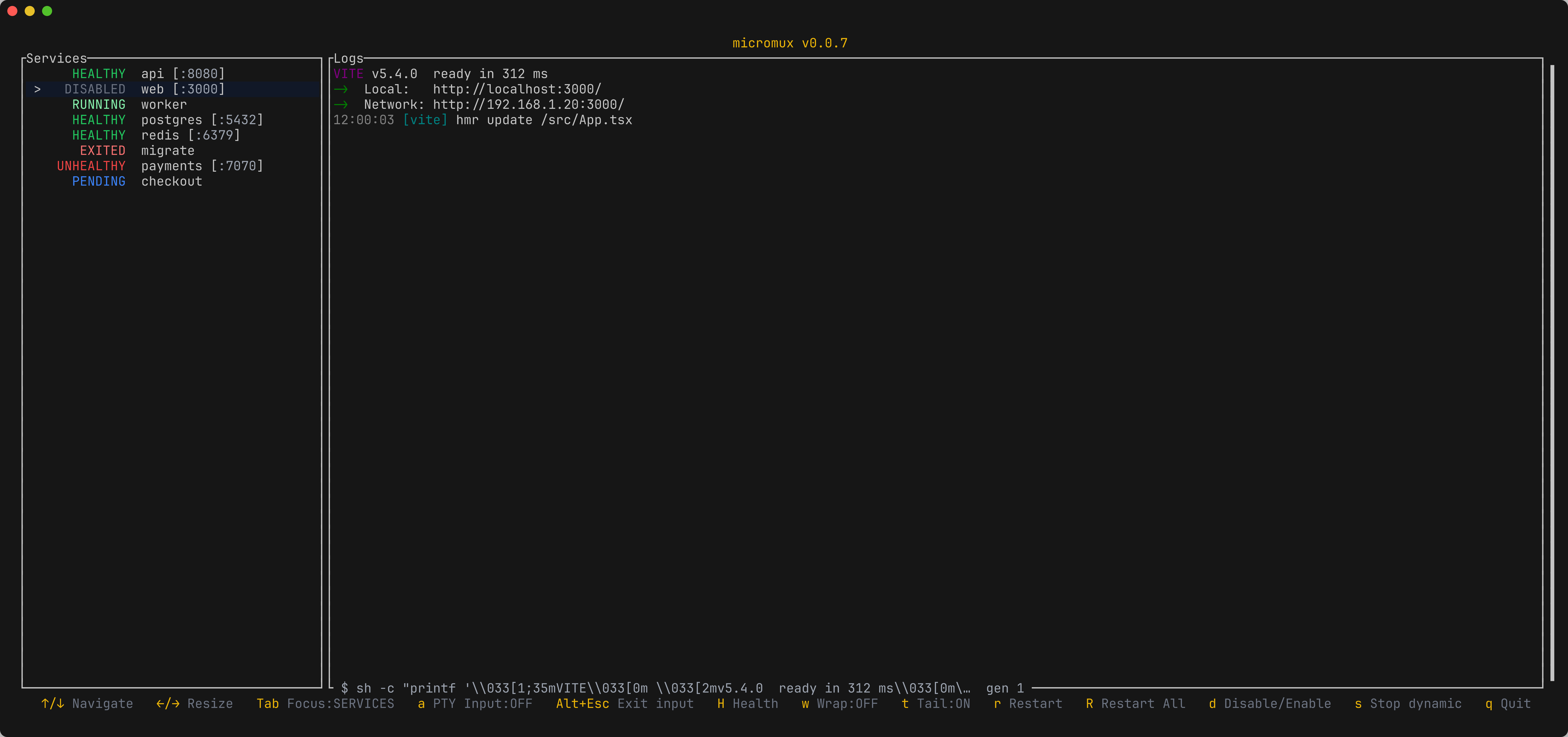
- Sidebar — every service, one row each, showing its lifecycle state: pending, starting, running, healthy, unhealthy, exited, or disabled. The selected row drives the panes on the right.
- Log pane — the selected service’s live output. ANSI color and interactive/redrawing output are supported.
- Healthcheck pane — toggled with
H, it shows the selected service’s latest probe: the command, its exit status, and its output.
Keybindings#
| Key | Action |
|---|---|
j / k, ↓ / ↑ | Move the selection |
r | Restart the selected service |
R | Restart all services |
d | Disable / enable the selected service |
a | Enter PTY input mode — send keystrokes to the service (exit with Alt+Esc) |
Tab | Move focus between panes |
H | Toggle the healthcheck pane |
w | Toggle log wrapping |
t | Toggle follow-tail (stick to the newest logs) |
q / Esc | Quit |
Restart, disable, and enable all go through the control plane, so they respect dependency gating and restart policy.
Sending input to a service#
Some processes want input — a REPL, a prompt, a dev server waiting on a keypress. Press a to enter input mode: keystrokes are forwarded to the selected service’s PTY until you leave input mode with Alt+Esc.
Disabling on the fly#
Press d to disable the selected service: micromux stops it and its row turns gray, while its captured logs remain for inspection. Press d again to re-enable and start it.
Attach to a running session#
When a session is running headless — started by an agent via micromux serve, or by start_session over MCP — open the same TUI against it without launching a second supervisor:
micromux attach                          # the session for the config resolved from the cwd
micromux attach --config ./micromux.yaml
micromux attach --session name:my-project
A selector may be a bare session name or name:, pid:, or hash:. More than one attach client can observe and operate the same session at once.
An attached TUI follows service status, logs, and healthchecks, and its lifecycle keys (r, R, d) still restart, enable, and disable services. In v1 it does not forward service PTY input or terminal-resize events.
Pressing
qorCtrl-Cin an attached client only detaches it — it never stops the session or its services. To stop a headless session explicitly, usemicromux ctl stopor the MCPstop_sessiontool.